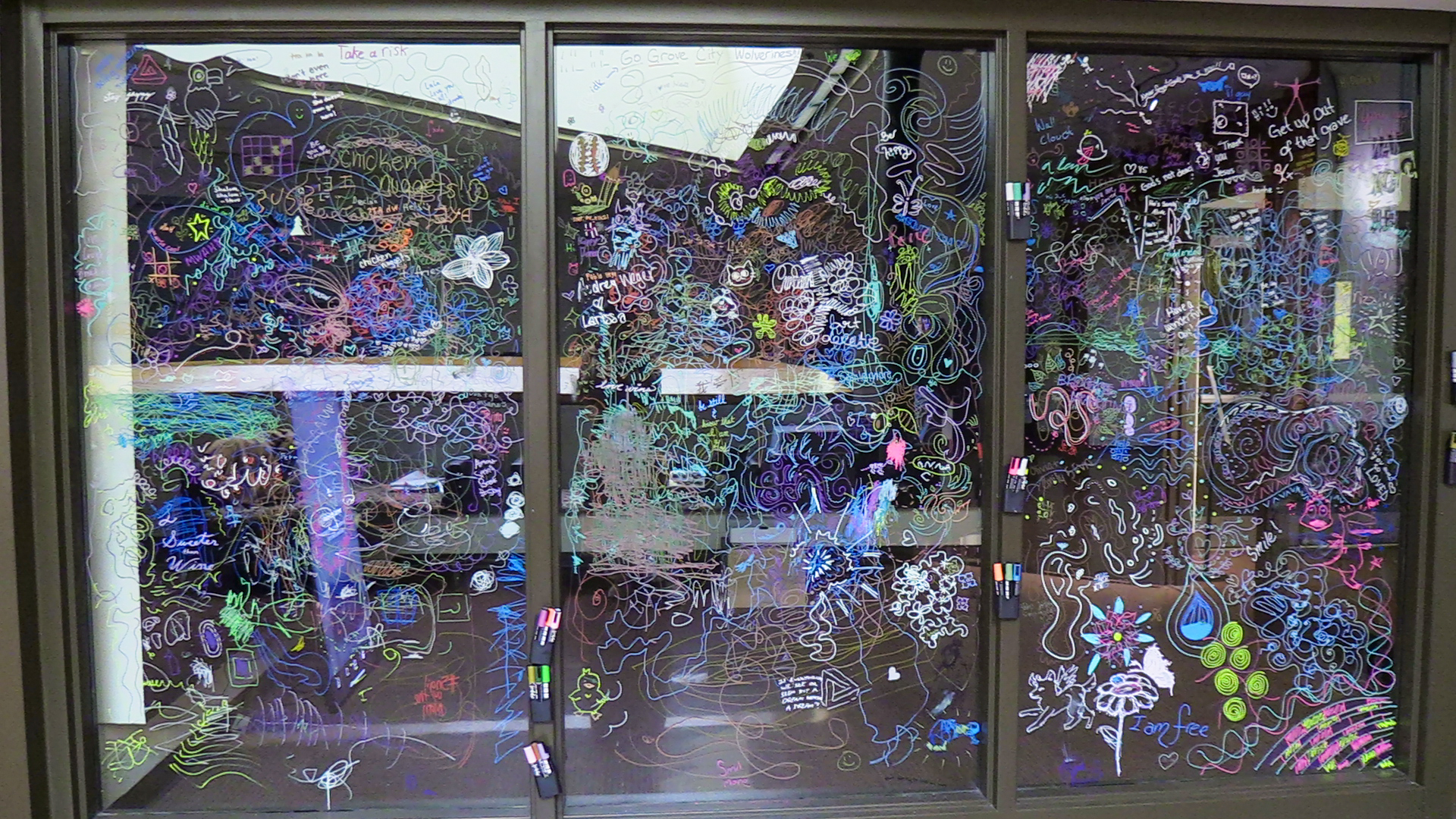




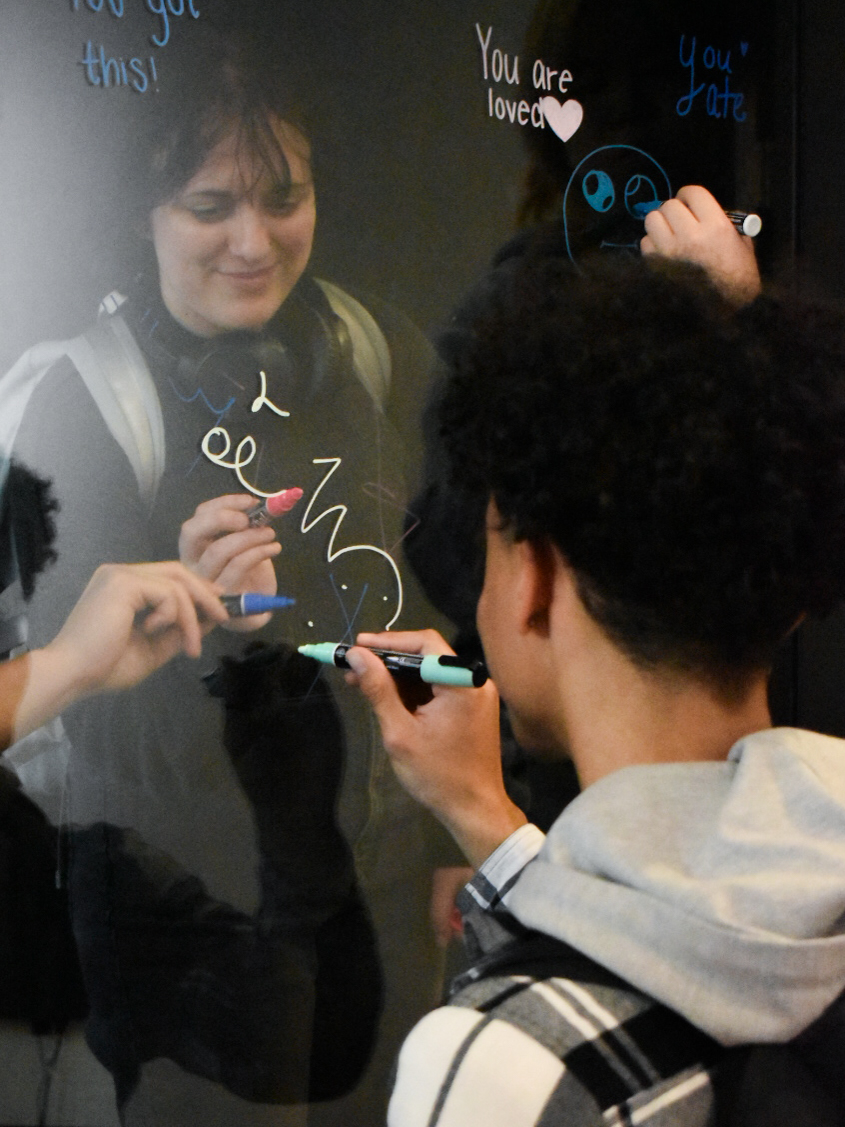
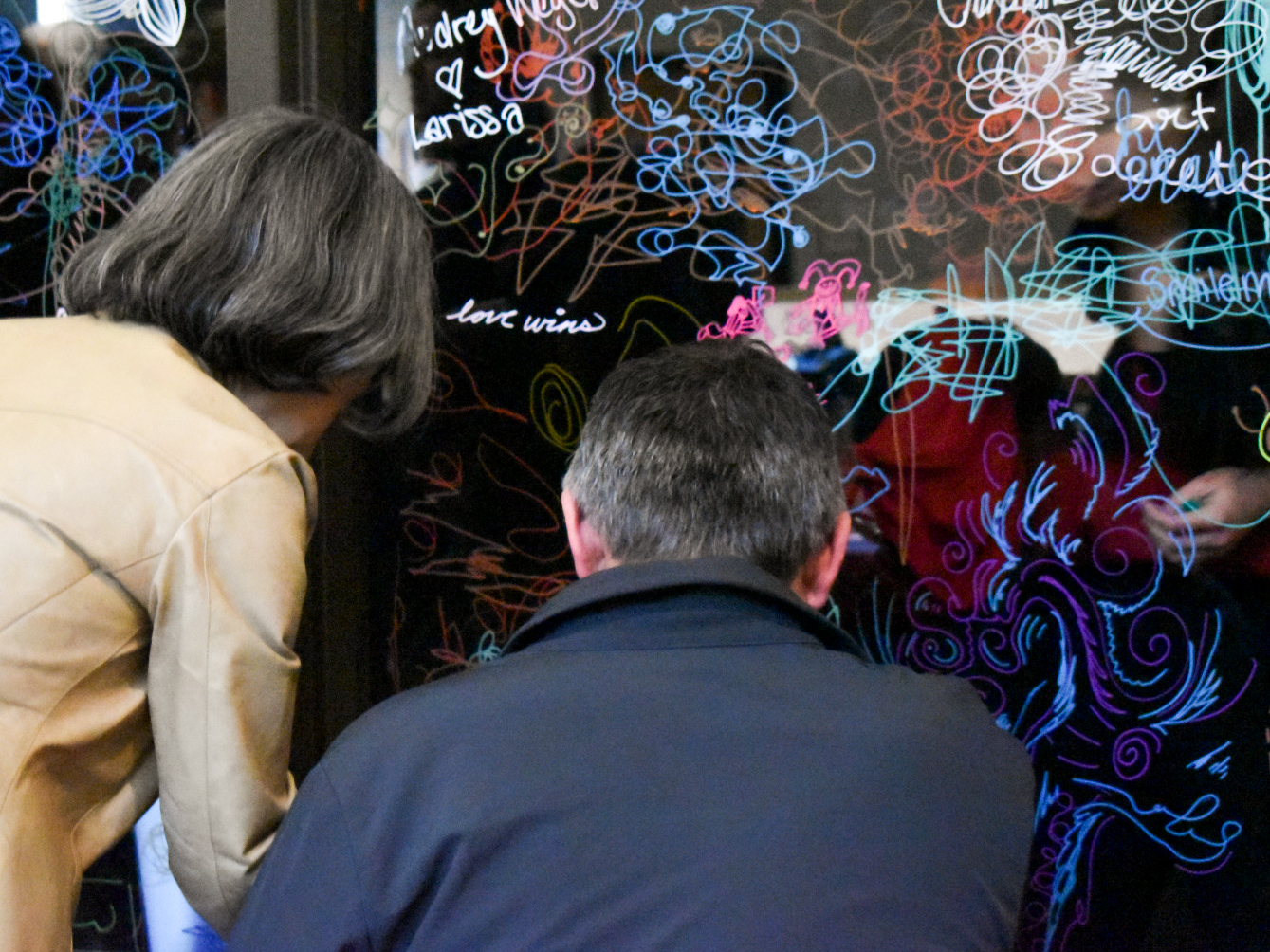


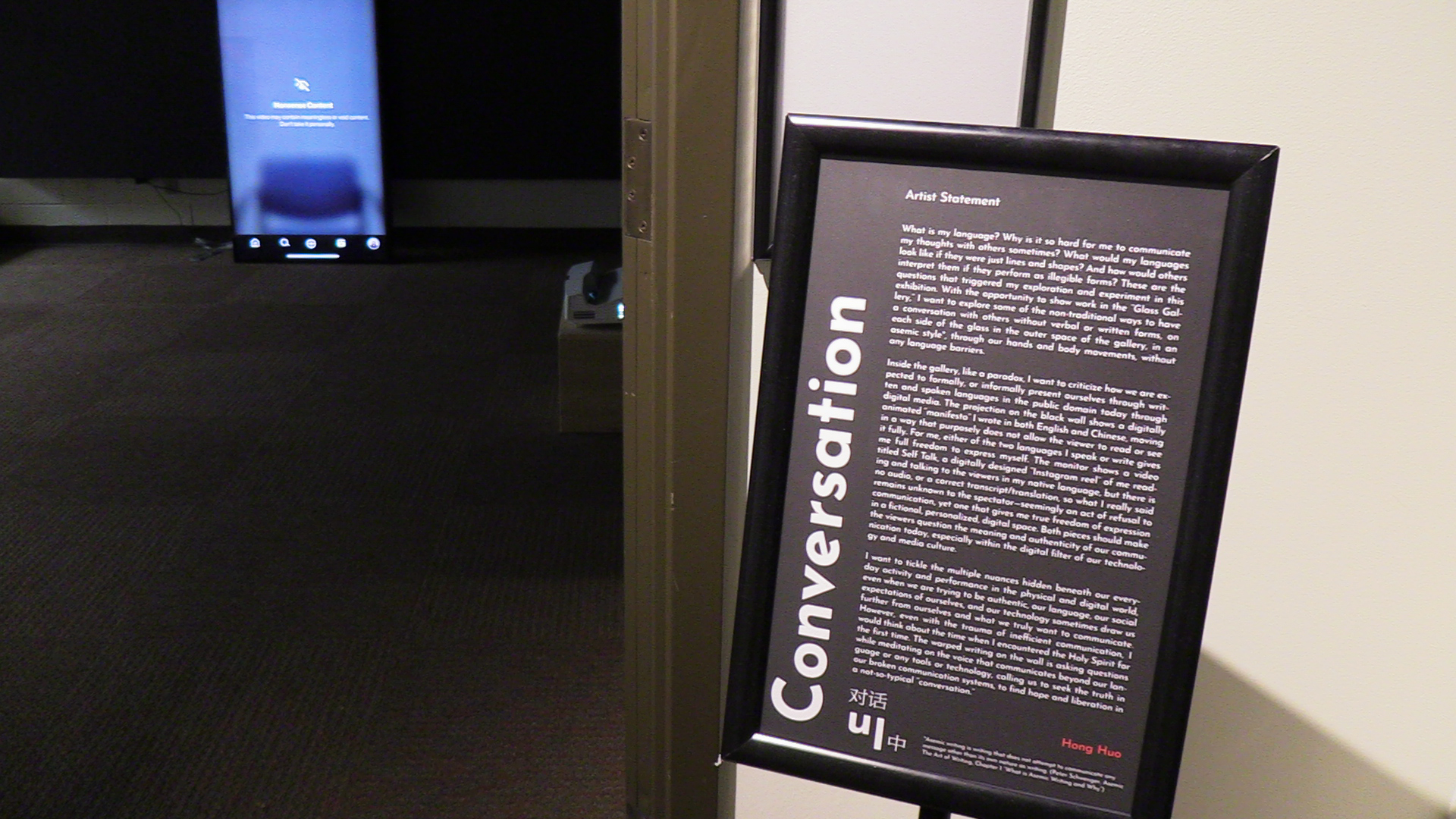

What is my language? Why is it so hard for me
to communicate my thoughts with others sometimes? What would my languages look
like if they were just lines and shapes? And how would others interpret them if
they perform as illegible forms? These are the questions that triggered my
exploration and experiment in this exhibition. With the opportunity to show
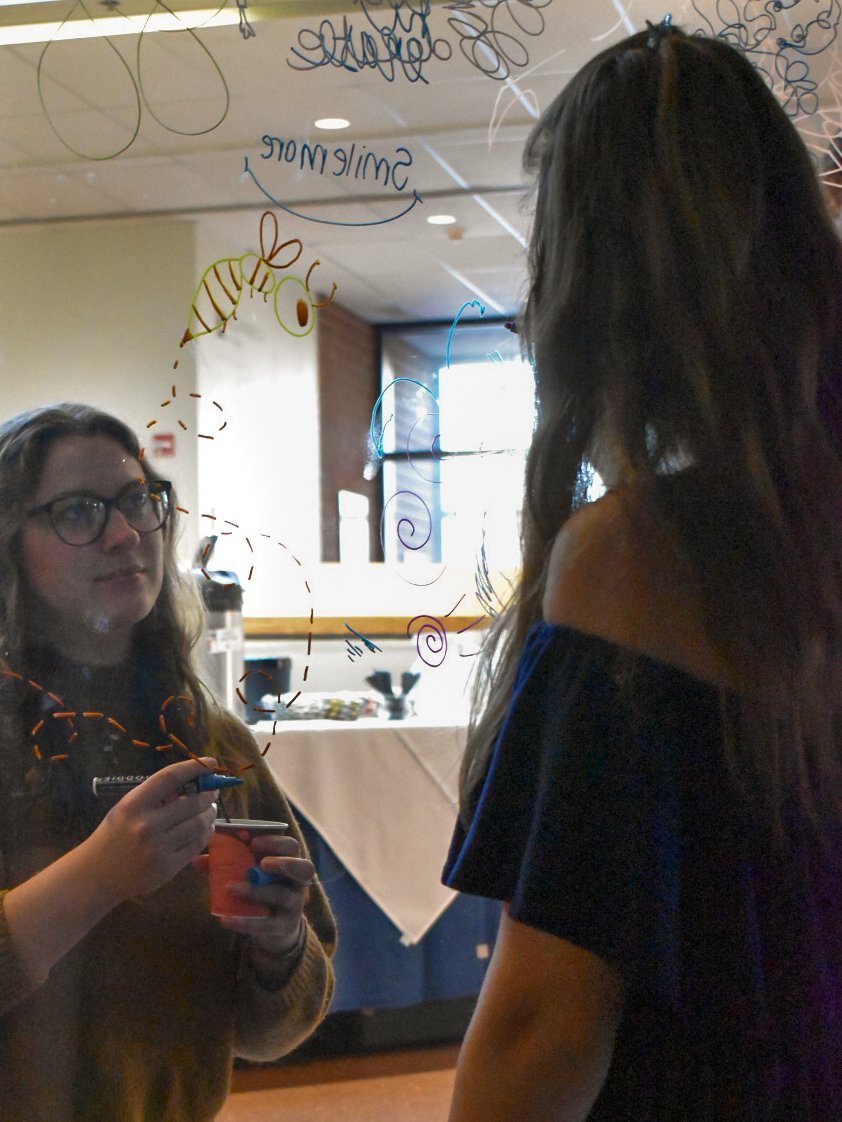
work in the “Glass Gallery,” I want to explore some of the non-traditional ways
to have a conversation with others without verbal or written forms, on each side
of the glass in the outer space of the gallery, in an asemic style*, through
our hands and body movements, without any language barriers.
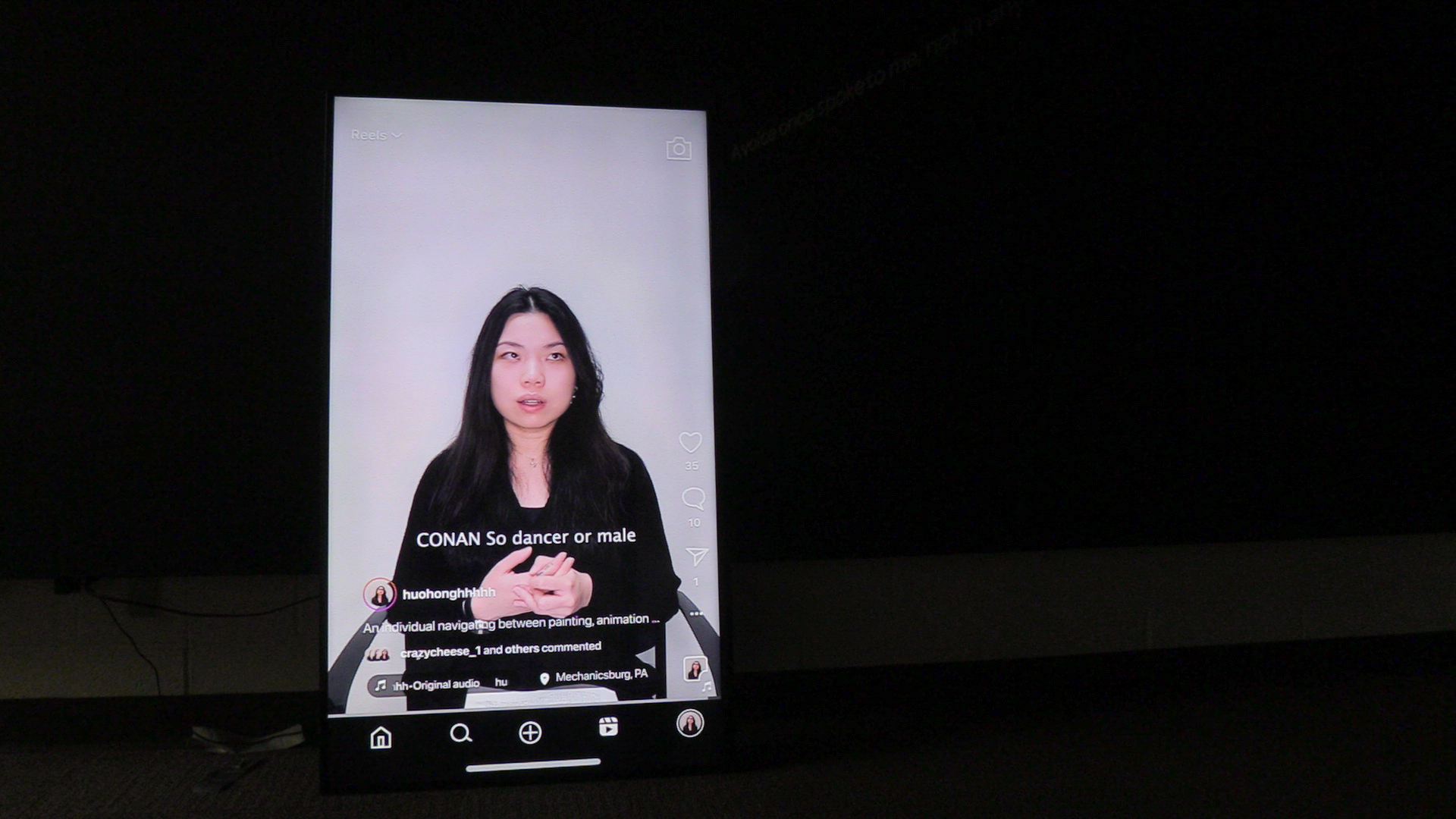
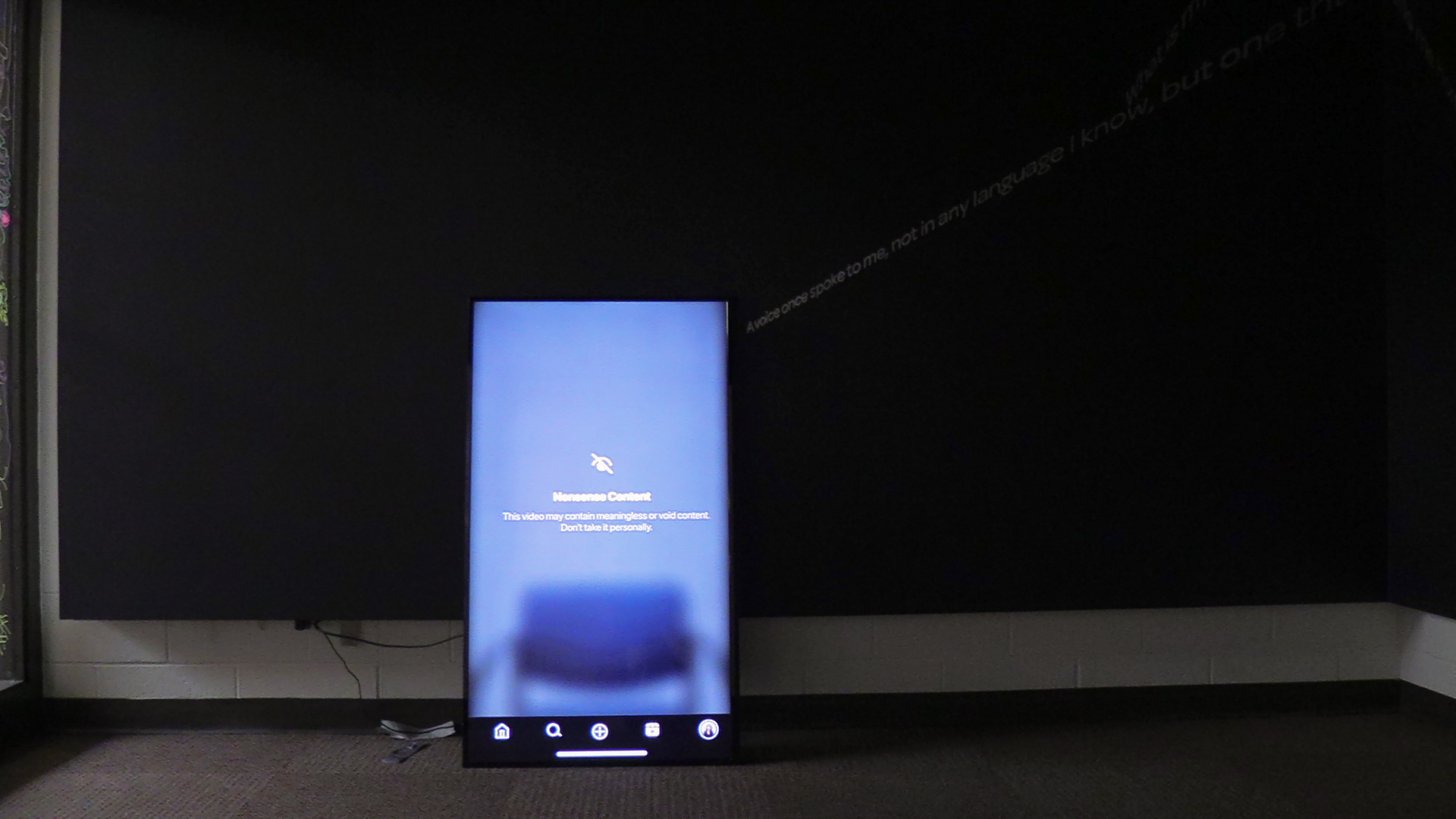
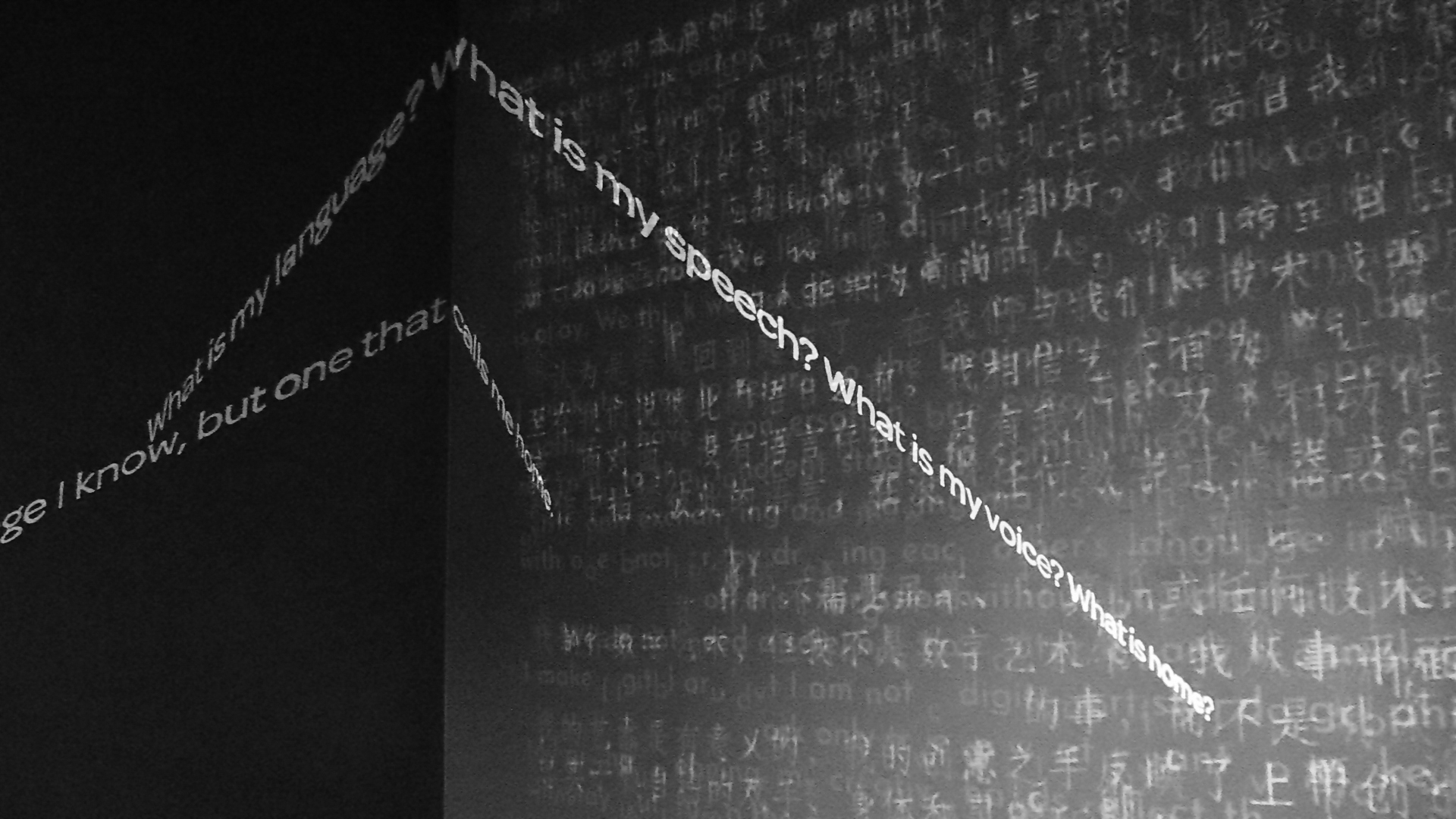
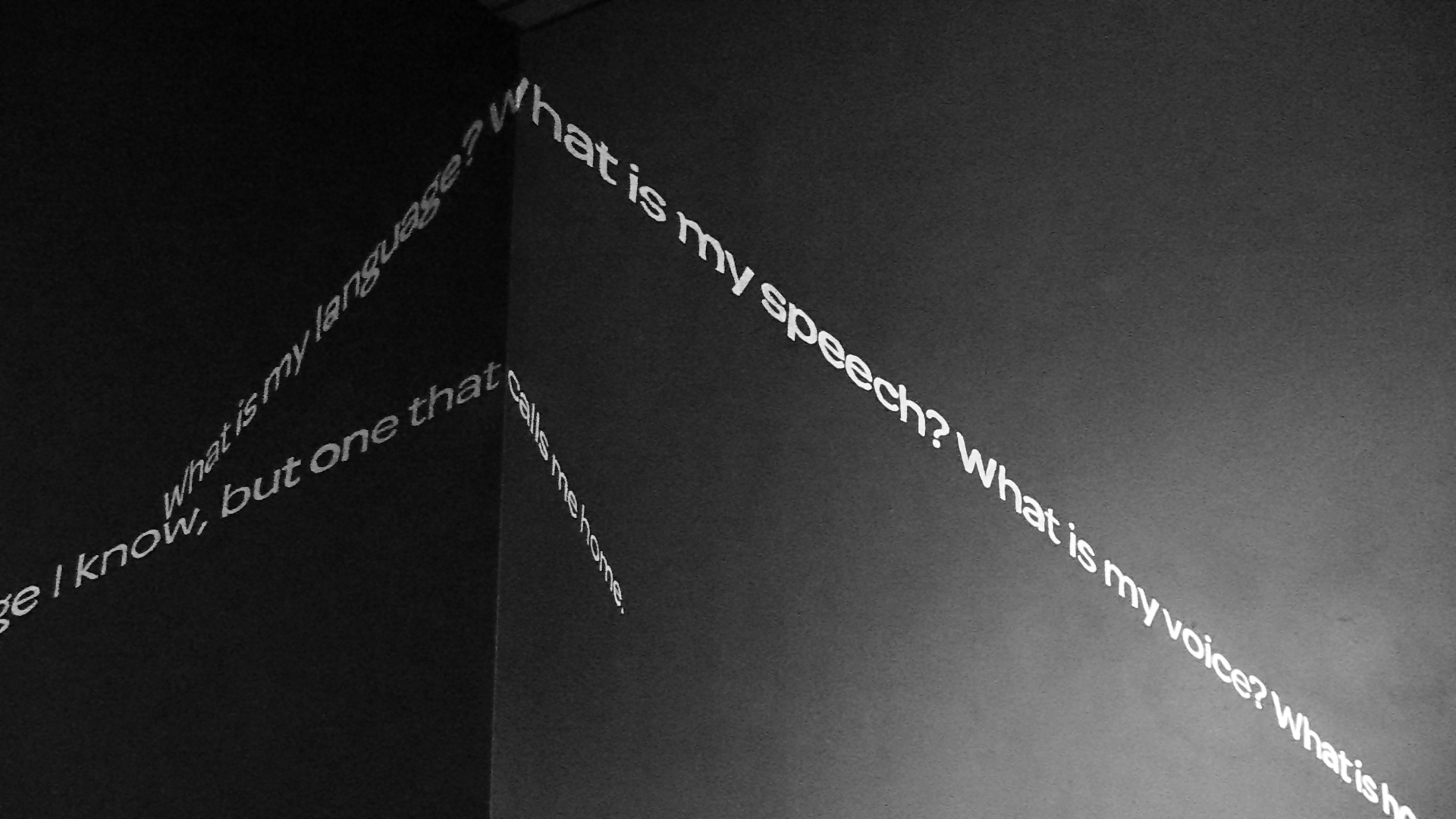
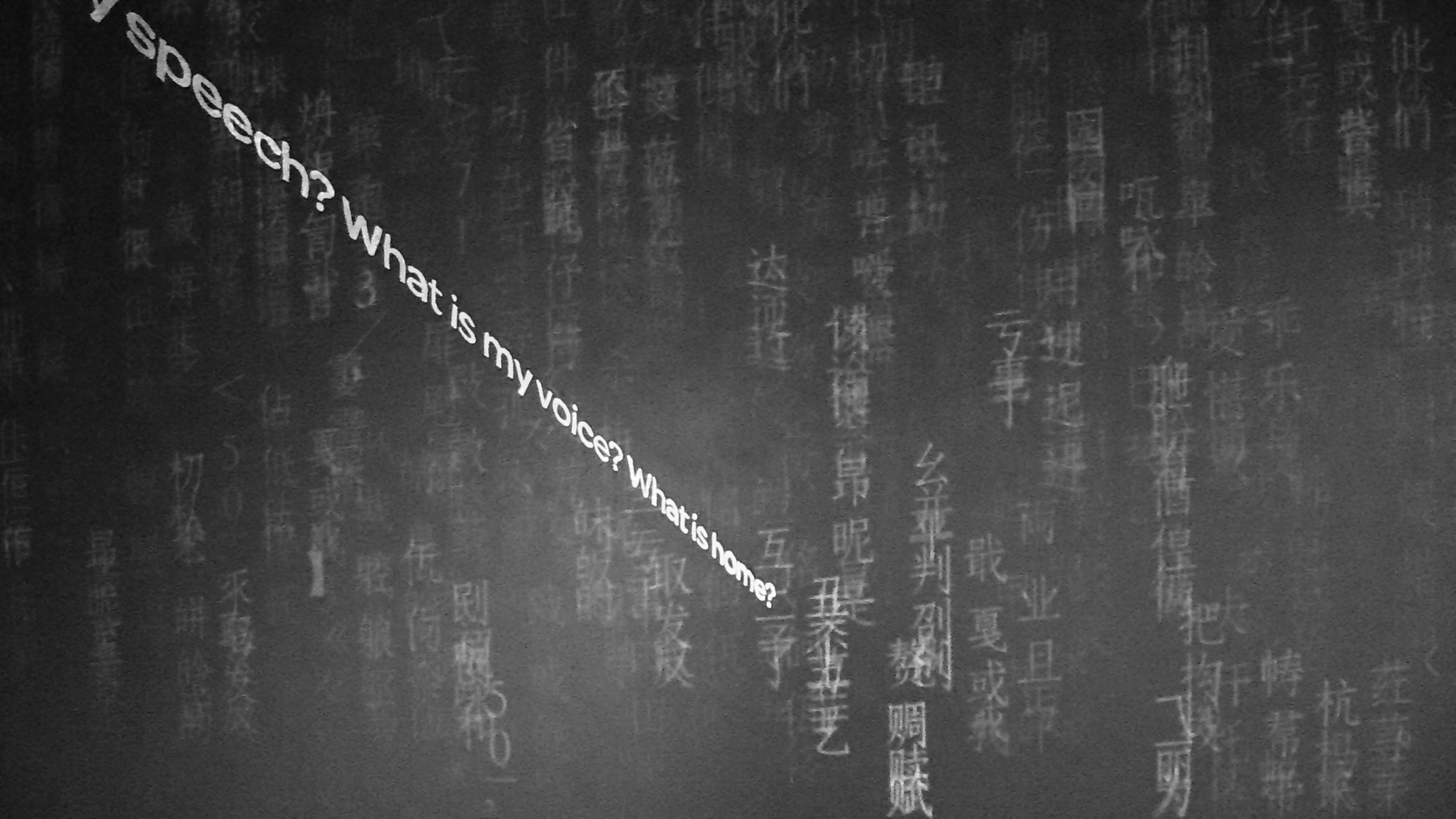
Inside the gallery, like a paradox, I want to criticize how we are expected to formally, or informally present ourselves through written and spoken languages in the public domain today through digital media. The projection on the black wall shows a digitally animated “manifesto” I wrote in both English and Chinese, moving in a way that purposely does not allow the viewer to read or see it fully. For me, either of the two languages I speak or write gives me full freedom to express myself. The monitor shows a video titled Self Talk, a digitally designed “Instagram reel” of me reading and talking to the viewers in my native language, but there is no audio, or a correct transcript/translation, so what I really said remains unknown to the spectator—seemingly an act of refusal to communication, yet one that gives me true freedom of expression in a fictional, personalized, digital space. Both pieces should make the viewers question the meaning and authenticity of our communication today, especially within the digital filter of our technology and media culture.
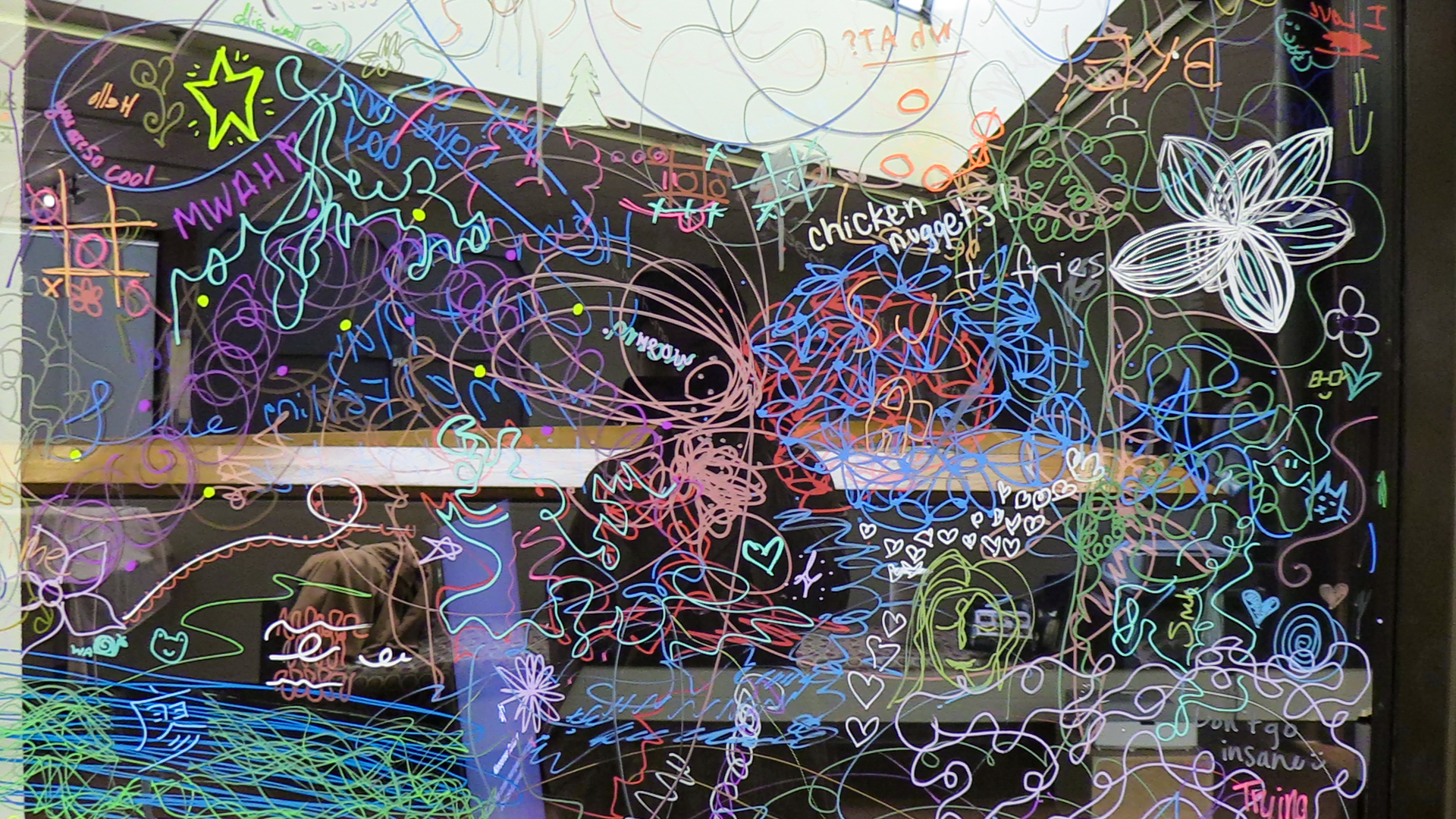
I want to tickle the multiple nuances hidden beneath our everyday activity and performance in the physical and digital world, even when we are trying to be authentic, our language, our social expectations of ourselves, and our technology sometimes draw us further from ourselves and what we truly want to communicate. However, even with the trauma of inefficient communication, I would think about the time when I encountered the Holy Spirit for the first time. The warped writing on the wall is asking questions while meditating on the voice that communicates beyond our language or any tools or technology, calling us to seek the truth in our broken communication systems, to find hope and liberation in a not-so-typical “conversation.”
------------
*Asemic writing is writing that does not attempt to communicate any message other than its own nature as writing. (Peter Schwenger, Asemic The Art of Writing, Chapter 1 “What is Asemic Writing and Why”)
Inside the gallery, like a paradox, I want to criticize how we are expected to formally, or informally present ourselves through written and spoken languages in the public domain today through digital media. The projection on the black wall shows a digitally animated “manifesto” I wrote in both English and Chinese, moving in a way that purposely does not allow the viewer to read or see it fully. For me, either of the two languages I speak or write gives me full freedom to express myself. The monitor shows a video titled Self Talk, a digitally designed “Instagram reel” of me reading and talking to the viewers in my native language, but there is no audio, or a correct transcript/translation, so what I really said remains unknown to the spectator—seemingly an act of refusal to communication, yet one that gives me true freedom of expression in a fictional, personalized, digital space. Both pieces should make the viewers question the meaning and authenticity of our communication today, especially within the digital filter of our technology and media culture.
I want to tickle the multiple nuances hidden beneath our everyday activity and performance in the physical and digital world, even when we are trying to be authentic, our language, our social expectations of ourselves, and our technology sometimes draw us further from ourselves and what we truly want to communicate. However, even with the trauma of inefficient communication, I would think about the time when I encountered the Holy Spirit for the first time. The warped writing on the wall is asking questions while meditating on the voice that communicates beyond our language or any tools or technology, calling us to seek the truth in our broken communication systems, to find hope and liberation in a not-so-typical “conversation.”
------------
*Asemic writing is writing that does not attempt to communicate any message other than its own nature as writing. (Peter Schwenger, Asemic The Art of Writing, Chapter 1 “What is Asemic Writing and Why”)
In Conversation
Interactive and multi-media installaion, 2/09-3/08/2024
Shown at the “glass gallery”, Department of Art and Design, Messiah University
Interactive and multi-media installaion, 2/09-3/08/2024
Shown at the “glass gallery”, Department of Art and Design, Messiah University


video documentation, 2/09-3/08/2024
Shown at the “glass gallery”, Department of Art and Design, Messiah University
Video Do